
This is a developing story.
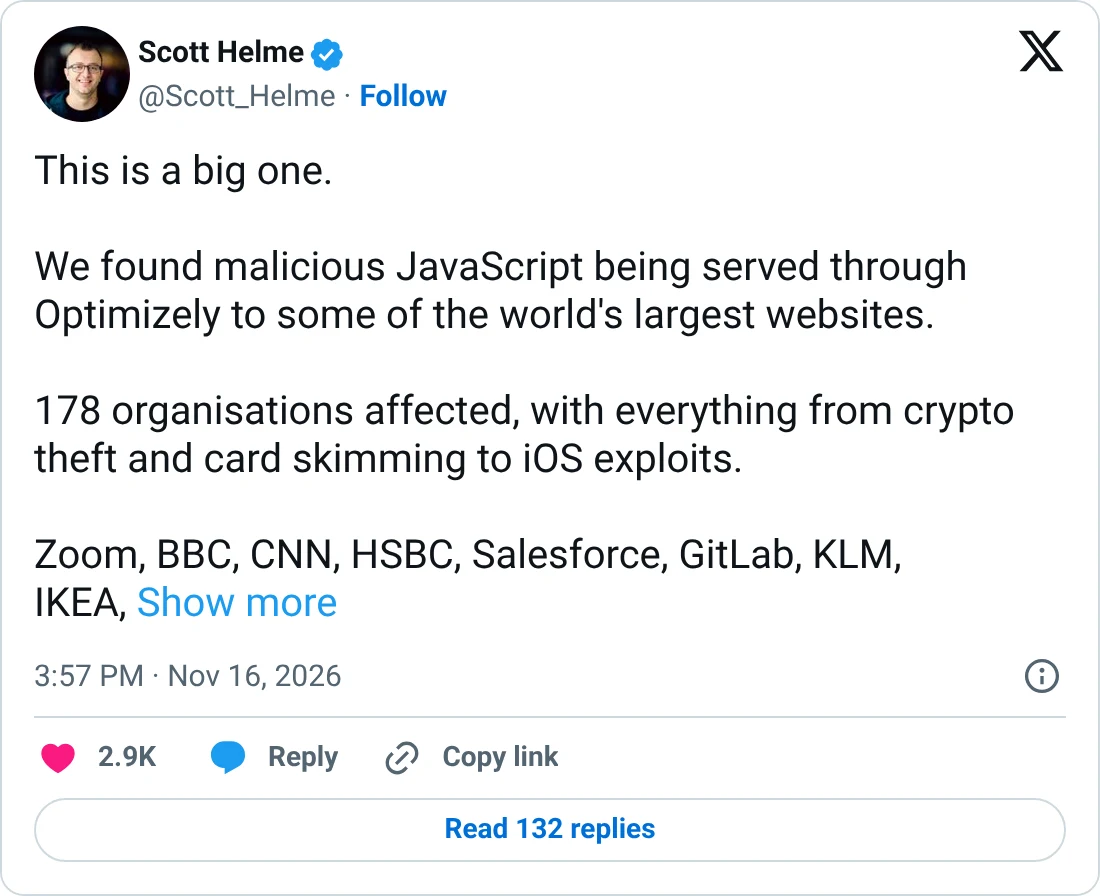
The Optimizely hack put malicious code on the websites of at least 178 organizations on Monday, Nov. 16, 2026, according to security firm Report URI. An attacker exploited a vulnerability in Optimizely's Web Experimentation platform, a tool companies use to test versions of their web pages, and planted JavaScript built to swap cryptocurrency wallet addresses, skim payment cards and target older iPhones and iPads.
The list includes Zoom, CNN, the BBC, HSBC, Equifax, Salesforce, GitLab, IKEA, Paychex and Peacock. Optimizely confirmed the incident and says it has fixed the vulnerability and removed the injected code.
What happened in the Optimizely hack?
Optimizely Web works by having each customer website load a JavaScript file, called a snippet, from Optimizely's servers. Each snippet includes an optional field where a customer can add its own code that runs on every page.
The attacker wrote code into that field in customer projects and left the rest of each snippet untouched, Report URI researcher Scott Helme wrote in the firm's analysis. Because the files still came from cdn.optimizely.com with Optimizely's own security certificate, every affected site already trusted them. Helme wrote that this "was not a CDN cache-poisoning attack" and that Optimizely's servers "served exactly what it was given."
Report URI checked 1,611 Optimizely snippets and found the malicious code in 188 of them, belonging to 178 organizations. It says the real count is likely higher because it could only check the snippets it found in time. Optimizely's own website and login page carried the code too.
Helme first flagged the attack on X on Monday afternoon.
What did the malicious code do?
Every visitor to an affected page received the same script, according to Report URI. What it did depended on the visitor's device and what they did on the page. Researchers at Report URI, BleepingComputer, Cynet and StepSecurity described four functions:
- Crypto address swapping. The script found real wallet addresses in page text, forms, links and the clipboard and replaced them with the attacker's. Report URI said an address copied from an affected page could paste as the attacker's.
- Card skimming. Added at 6:43 a.m. Mountain Time on Nov. 16, it captured card number, expiration date and security code from a site's own form fields. Cards entered in hosted payment fields, such as Stripe's or Adyen's, were out of its reach, Report URI and StepSecurity said.
- Cookie and screenshot theft. When it swapped an address near payment wording, the script sent the page address, readable cookies and a screenshot of the page to the attacker, Report URI said.
- iPhone and iPad exploits. On Apple mobile devices, the script loaded exploit kits that Report URI identified as Coruna and DarkSword, which target older iOS versions. The kit's own code marks iOS 18.7.3 and later, and iOS 26.3 and later, as patched, the firm said.
No researcher has reported an iPhone actually being taken over. Cynet described what it captured as conditional delivery and "not a successful compromise of a physical iPhone or iPad." "The current evidence does not establish a zero-day, successful device exploitation, or collection of specific device data by unseen downstream stages," Hudson Rock said, SecurityWeek reported.
How much was stolen?
The full amount is unknown. Report URI said the attacker's crypto wallets had received about $7,040 as of 12:25 p.m. Mountain Time on Nov. 16, "all within roughly nine hours." Its later update listed about $7,150 across five wallets, which the attacker emptied overnight.
Estimates differ. BleepingComputer put the figure at roughly $7,000. StepSecurity counted about $6,600 and noted that two of the addresses were in use before the attack began, so "the chain does not show which transfers came from victims," The Hacker News reported.
Card losses are harder to count. "We have no way to see how many credit cards were skimmed, how many cookies or screenshots were stolen, or how many iOS devices were infected before the attack was stopped," Report URI wrote.
What has Optimizely said?
Optimizely posted on its status page at 6:02 p.m. Mountain Time on Nov. 16: "Earlier today, Optimizely identified a security incident in which an unauthorized party exploited a vulnerability in Experimentation and used it to add malicious JavaScript to some customer projects. We've fixed the vulnerability and removed the injected code from affected projects."
It added that it had secured affected user accounts and "put additional protections in place to prevent unauthorized code from being delivered." As of 9:55 a.m. Mountain Time on Nov. 17, the incident was still marked "Monitoring." Report URI said in a Nov. 17 update that the attacker's main payload server, 1688360.cc, was put on hold by its registry at 5:37 p.m. Mountain Time on Nov. 16 and no longer resolves, and that a second attacker domain, webshell.lol, was put on hold at 8:37 p.m. Mountain Time. Researchers have nicknamed the campaign "OPTIMJACK."
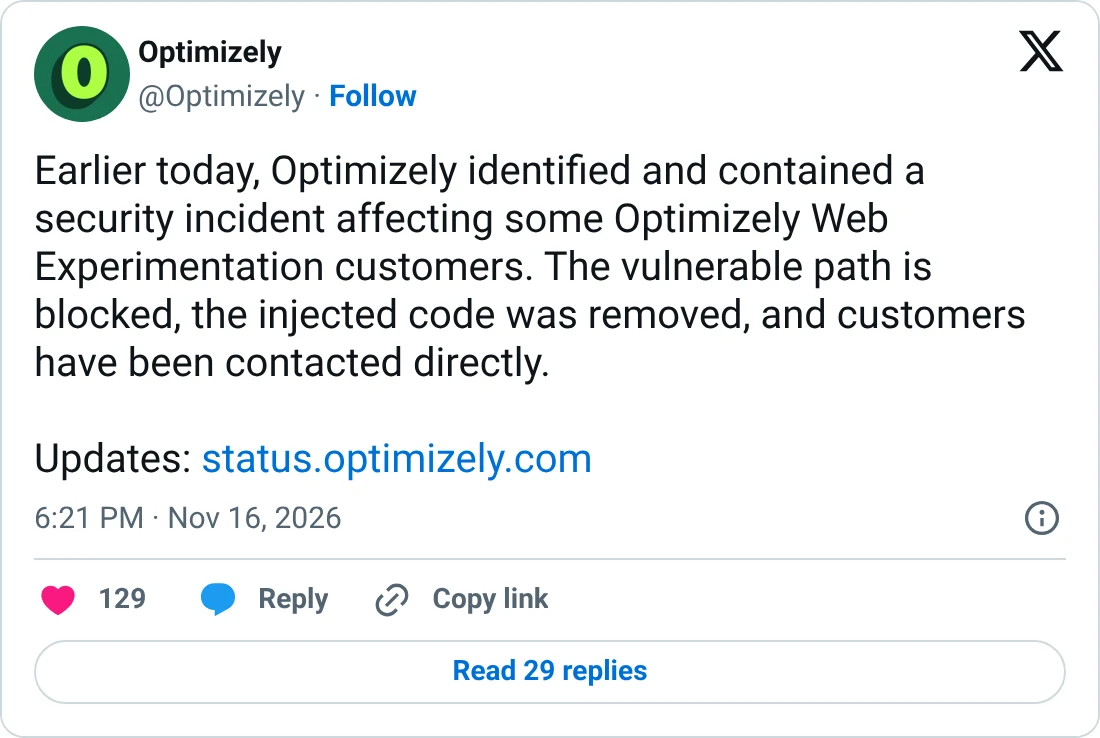
In a statement to BleepingComputer, Optimizely was more specific. It said the attacker "exploited a vulnerability in the Experimentation account signup flow." The company said it had ended active sessions, revoked tokens, reset access for affected accounts and notified all affected customers.
Optimizely has not said how many customers were affected or how long the vulnerability existed. SecurityWeek noted that Optimizely disclosed a separate incident in February, when a threat actor reached its systems through a voice-phishing attack.
How long did it last?
All times below are Mountain Time, converted from Report URI's UTC timeline.
- Nov. 15, 9:21 p.m.: First Optimizely injection seen, in the BBC's snippet.
- Nov. 16, 6:43 a.m.: Card skimmer added to the attack script.
- Nov. 16, 12:24 to 12:59 p.m.: Report URI's sweep finds 186 of 1,611 snippets infected.
- Nov. 16, about 1:40 to 2:10 p.m.: Mass cleanup.
- Nov. 16, 2:52 p.m.: Only TalkTalk's snippet still infected.
- Nov. 16, 4:11 p.m.: All infected Optimizely files Report URI tracked are clean.
- Nov. 16, 5:37 p.m.: The attacker's main server domain is suspended and stops resolving.
Smartsheet's snippet was cleaned once and then re-infected with a hidden version of the code, which "indicates the attacker still had access at that point," The Hacker News reported, citing Report URI.
Optimizely was one of several delivery routes. Report URI and Hudson Rock said scripts from Kissmetrics, StorifyMe and Minute Media served a related loader starting Nov. 13, SecurityWeek reported.
What are affected companies saying?
- Equifax told Newsweek it "immediately investigated this issue and ceased our use of Optimizely" and has "not identified evidence of any compromise to our systems or impact to our data."
- Salesforce told BleepingComputer that "Optimizely scripts are disabled across preview and production instances" and that it will notify affected customers "without undue delay" if it finds unauthorized access to their data.
- IKEA told Newsweek it is investigating "to understand any potential impact on our digital services and customers."
- HSBC said unauthorized scripts were not active on its websites, Reuters reported. Report URI wrote that HSBC's security policy blocked the main attack script, though an inline copy of the code still ran.
- Apple, Zoom and CNN did not immediately respond to Reuters' requests for comment.
Researchers stress that appearing on the list does not mean a company's own systems were breached. "A website can be compromised through a third-party dependency without its own code or infrastructure ever being breached," Helme wrote.
Which websites were affected?
Report URI published the full list of 178 organizations. Newsweek republished it grouped by sector. Some names are individual websites or regional services, and a few appear twice in the original list.
Several of the names run tools that businesses use every day, including payroll (Paychex), small business lending (OnDeck, Funding Circle), tax filing (TaxAct), shipping (ShipStation, Stamps.com), property management (Buildium) and restaurant ordering (order.online).
- Banking and finance (32): Paychex; HSBC US; Equifax; SmartAsset; HSBC Hong Kong; ABN AMRO; TaxAct; HSBC Mexico; HSBC Singapore; NetCredit; Associated Bank; S-Pankki; Equifax Canada; Equifax UK; The Work Number; Funding Circle; HSBC Australia; CashNetUSA; OnDeck; ICS Cards; HSBC UAE; HSBC Malaysia; Rest Super; HSBC Taiwan; HSBC Vietnam; HSBC Egypt; HSBC Philippines; SmartAdvisor Match; Compare Club; ABN AMRO Lease; Energy Scout; Hang Seng Investment
- Technology and software (23): Zoom; Bitly; Salesforce; GitLab; Optimizely; Mixpanel; Typeform; InMotion Hosting; Wasabi; Perforce/Zend/Puppet; Tableau; Hootsuite; Smartsheet; MuleSoft; Thales/Imperva; Tricentis; Web Hosting Hub; QR Code Generator; ServiceChannel; Brandfolder; Intelex; Enverus; Accruent
- Retail and fashion (20): IKEA; ASOS; Mattel; American Eagle; Scheels; Ariat; American Girl; StackSocial; Crocs India; Levi's Japan; Todd Snyder; Levi's Indonesia; Just Russel; Loloi Rugs; Levi's Australia; Levi's Malaysia; Levi's Philippines; Levi's Singapore; Levi's Korea; Levi's New Zealand
- Streaming and entertainment (12): Peacock; D&D Beyond; Wizards of the Coast; NOW TV; Zattoo; Crave; Starz; SkyShowtime; Bravo; SeaWorld; WOW (Sky Deutschland); NOW Italia
- News and media (10): CNN; BBC; Fox News; NPR; CTV News; Fox Sports; BNN Bloomberg/CP24; TSN; Top Gear; BBC Earth
- Airlines and travel (9): Alaska Airlines/Hawaiian Airlines; Transavia; Air France-KLM; KLM Netherlands; Trafalgar; Contiki; Insight Vacations; The Travel Corporation; Costsaver
- Healthcare and pharmaceuticals (8): Invisalign; Takeda; Covetrus; iTero; Covetrus Pharmacy; myCovetrus; RaySafe; Takeda Oncology
- Industrial and manufacturing (8): Fluke; eMaint; Fluke Networks; Vaillant Germany; Fluke Process Instruments; Fluke Biomedical; Landauer; Vaillant Spain
- Telecommunications (7): Virgin Media; Virgin Media O2; Vodafone Australia; O2; TPG Telecom; Mint Mobile; TalkTalk
- Cryptocurrency and trading (6): Ledger; IG; OANDA/Coinpass; Interactive Investor; TMS Brokers; Betashares
- Insurance (6): Asurion/uBreakiFix; Mutual of Omaha; Admiral; Securian Financial; eRenterPlan; AKA
- Property and real estate (6): Buildium (managebuilding.com); Loft Living apartments; Buildium; HireAHelper; Flytte.no and sister comparison sites; MovingPlace
- Food and hospitality (5): Restaurant ordering sites (order.online); Heineken; Home Chef; Starbucks Canada; Cinnabon
- Home and smart home (5): Resideo; Honeywell Home; myQ; Chamberlain; First Alert
- Nonprofit and civic (4): Change.org; ASPCA; UNICEF USA; DonorsChoose
- Gambling (4): Betsson; PokerStars; Tombola; Betfred
- Professional services (4): Freshfields; CohnReznick; Baringa; Cro Metrics
- Logistics and shipping (3): ShipStation/ShipEngine; Stamps.com; ShipEngine
- Automotive (3): Lucid Motors; O'Brien Glass; Chevrolet dealer network, including Bill Rapp
- Education (3): Walden University; Perlego; Chamberlain University
Source: Report URI's investigation, as republished by Newsweek on Nov. 17, 2026.
What are visitors being told to do?
For anyone who visited an affected site on Nov. 16, Report URI, BleepingComputer and Newsweek pointed to the same short list:
- Update iPhones and iPads to iOS 18.7.3 or later, or iOS 26.3 or later.
- Compare any crypto payment sent that day with the address you meant to pay.
- If you entered card details on an affected site, watch your statements and contact your card issuer about charges you don't recognize.
Newsweek noted that "simply opening a website does not mean information was stolen."
Was the Optimizely hack connected to the NSA outage?
No source has linked them. The NSA Net outage CNN reported on Nov. 17 involved a classified internal government network, and CNN's sources said there was no evidence of a cyberattack. We covered it in NSA Network Down.
The Optimizely attack also landed a day after the Chase banking disruption, which Chase blamed on a software bug in on-premise hardware. We covered that in Is Chase Down? Some viral posts on X tied this week's bank outages to the Optimizely attack. We found no company, researcher or official confirming any such link.
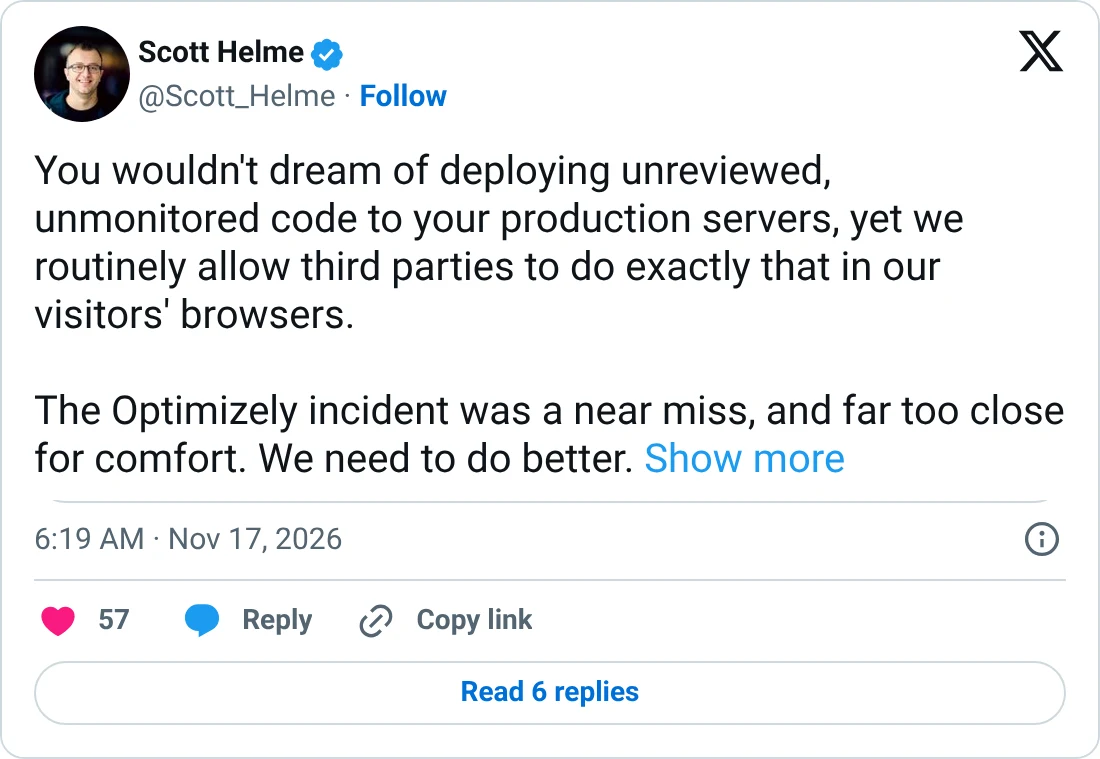
Helme summed up the episode on X Tuesday morning.
What we don't know yet
- How the signup flow vulnerability worked and how long it existed
- How many Optimizely customers were affected in total
- How many cards, cookies or screenshots reached the attacker
- Whether any iPhone or iPad was actually compromised
- Who is behind the attack
We will update this post as Optimizely and affected companies share more.
Following the story
When the headlines move this fast, it helps to have someone keeping an eye on your numbers. Book a 30-minute call in the next two weeks.
Learn more about our fractional CFO services.
About the author: Enoch Sng is Managing Partner of Black Lotus Financial Group. He started his finance career in 2019 in real estate private equity and later owned and operated one of the largest self-storage facilities in Utah. Today he helps small business owners with fractional CFO support, bookkeeping, cash flow, and exit prep.
Sources
- Report URI, Scott Helme, "World's Largest Brands Infected With Malware Via Optimizely," Nov. 16, 2026, updated Nov. 17, 2026, 2:17 a.m. Mountain Time (09:17 UTC): https://blog.report-uri.com/worlds-largest-brands-infected-with-malware-via-optimizely/
- Optimizely status page, "Web Experimentation Security Incident," Nov. 16, 2026, 6:02 p.m. Mountain Time (01:02 UTC Nov. 17): https://status.optimizely.com/
- Optimizely, post on X, Nov. 16, 2026, 6:21 p.m. Mountain Time: https://x.com/Optimizely/status/2122500375727194333
- Scott Helme, post on X, Nov. 16, 2026, 3:57 p.m. Mountain Time: https://x.com/Scott_Helme/status/2122464168989098461
- Scott Helme, post on X, Nov. 17, 2026, 6:19 a.m. Mountain Time: https://x.com/Scott_Helme/status/2122680971539419584
- BleepingComputer, Lawrence Abrams, "Optimizely hack infected CNN, Fox News, BBC, Salesforce sites with malware," Nov. 16, 2026: https://www.bleepingcomputer.com/news/security/optimizely-supply-chain-attack-infects-major-brands-sites-with-malware/
- SecurityWeek, Eduard Kovacs, "Optimizely Vulnerability Exploited to Serve Malware on Major Websites," Nov. 17, 2026, 3:22 a.m. Mountain Time: https://www.securityweek.com/optimizely-vulnerability-exploited-to-serve-malware-on-major-websites/
- The Hacker News, Swati Khandelwal, "Hijacked Optimizely Scripts Served Card Skimmer and iOS Exploit Kits to CNN, BBC and Zoom Visitors," Nov. 17, 2026: https://thehackernews.com/2026/11/hijacked-optimizely-scripts-served-card.html
- The Register, Carly Page, "Optimizely hack turns world's biggest websites into malware dispensers," Nov. 17, 2026, 7:00 a.m. Mountain Time: https://www.theregister.com/cyber-crime/2026/11/17/optimizely-hack-turns-worlds-biggest-websites-into-malware-dispensers/5310448
- Reuters, "Popular websites compromised in bid to steal crypto, target iPhone users," via Business Recorder, Nov. 17, 2026: https://www.brecorder.com/news/40449374
- Newsweek, Chris Matthews, "Cyber Attack Hits 178 Major Websites: Full List of Affected Organizations," Nov. 17, 2026, updated 8:40 a.m. Mountain Time: https://www.newsweek.com/cyber-attack-websites-affected-12725863
- Cynet, Joseph Bryant, Or Livne and Shivtej Tata, "OPTIMJACK: Malicious web injection across CNN, Zoom, Salesforce, Fox and more," Nov. 17, 2026: https://www.cynet.com/blog/optimjack-malicious-web-injection-across-cnn-zoom-salesforce-fox-and-more/
- CNN, "Exclusive: Highly classified US national security communications network goes down, sources say," Nov. 17, 2026: https://www.cnn.com/2026/11/17/politics/highly-classified-national-security-communications-network-goes-down